
Play Now
Join a Game
Characters
Shop
Tools
Compendium
Community

Sign In

Play Now
Join a Game
Characters
Shop
Tools
Compendium
Community
Sign In
"Just look at you. It breaks my heart. Your tiny nose can’t catch the stories carried on the wind. Your ears are flat and useless. You wobble so slowly on your two feet… each moment, I fear that you will fall. And all for what? Your clever hands and what you build with them? You wouldn’t need steel if you had real teeth, nor walls if you weren’t so afraid of rain and snow. It is so sad to see you. But we cannot all be worgs.”
—The worg Ja’taarka
What is a worg? The people of the Five Nations generally think of them as talking wolves. In his Codex Carnivorous, Dorius Alyre ir’Korran concluded that worgs were wolves that had been altered by Dhakaani magebreeders. He further stated that “... the worg is an evil predator that delights in hunting and devouring creatures weaker than itself.”
Everything about this is wrong. The word “worg” is a flawed form of what these creatures call themselves—wuura’gaa, the children of the wood. They are a unique canid species, distinct from wolves and dogs. The Dhakaani worked closely with worgs, and because of this, small populations of worgs can be found across Khorvaire in places where the Dhakaani had strongholds. But the goblins didn’t create the worgs… and worgs are no more inherently evil than goblins, gnomes, or humans.
There is a vast, dense rainforest located southwest of the Great Crag. The worgs call it Wuura Chotaa, The Watching Wood. It is a hypernatural environment, like some Lamannian manifest zones; it is impossible to tame the Wood or to establish outposts within it; any structures will be overcome by accelerated growth and decay. This is the birthplace of the worgs. Despite its traits, it is not tied to Lamannia. It doesn’t look outwards; the Wood watches what lies within. There is a vast pit in the center of the Watching Wood, surrounded by rotting vegetation and sludgy soil. The Worgs call this Nuushka, the Wound. They say it is a wound inflicted on the First Mother at the dawn of creation—an injury inflicted on Eberron by Khyber’s claws. The hypernatural traits of the Watching Wood are a response to the Wound. The fiends and foul things that emerge from the Wound are torn apart by the denizens of the Wood, never reaching the world beyond. Because of this, the Watching Wood is home to a vast array of monstrosities and beasts, both dire and horrid. It’s worth noting that these monstrosities may seem monstrous to humans—but they are children of Eberron, distinct from aberrations. And it is the hypernatural power of Eberron that resisted both the corruption of Avassh and the force that shaped the Barrens.
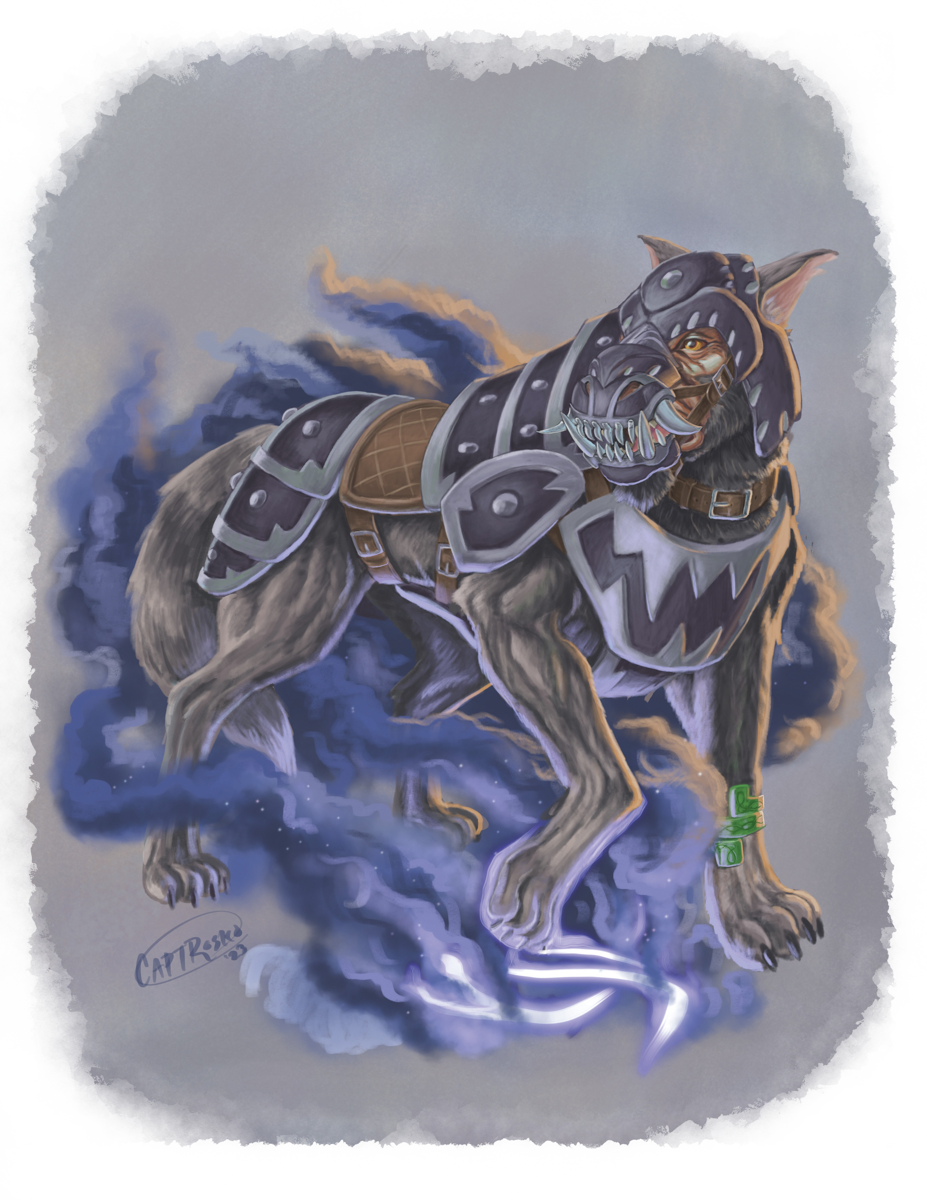 There are thousands of worgs in the Watching Wood. Their packs are united by common traditions and an instinctive bond to contain the threat of the Wound, but there are a number of unique subcultures—not unlike the Lhazaar Principalities. The Stone Fangs are the fiercest warriors of the inner woods. The worgs of The Menagerie have developed a shapeshifting tradition that mirrors the druidic Circle of the Moon. The Marrowbound turn the power of the Wound against its spawn, pursuing a warlock path. But these packs dwell in the deep woods, and most have never seen or been seen by humanoids. It is the worgs of the outermost woods that interact with outsiders. In the past, they have been known as the Calador, loosely translated as the Uncaged or the Restless. It is the Calador who left the wood to work with the Dhakaani. But a century ago, the elf werewolf Zaeurl came to the Watching Wood, leading an exodus of lycanthropes from Aundair and the Eldeen Reaches. Zaeurl forged an alliance between her refugees, the Calador worgs, and other sentient predators of the outer woods. Together they became the Ghaal’kechan—the Great Pack. Where the Calador had previously kept to the woods and kept others out of it, under Zaeurl’s leadership they began to interact with the humanoids on the edge of their domain, forming ties with the gnolls of the Znir Pact and the changelings of Lost. As Droaam rose from the Barrens, Zaeurl accepted the title of warlord—and many among the Ghaal’kechan chose to leave the Watching Wood and become a part of this greater pack.
Dark and Dusk. The worgs loyal to Zaeurl call themselves the Great Pack. The alliance includes an elite force of worg and werewolves known as Vanon’kechan, the Dusk Pack. These canid commandos were much feared by Brelish forces during the Last War. Due to poor translation, the easterners called the enemy “the Dark Pack” and applied this name to all Droaamite worgs. So, people of the Five Nations—and prior sourcebooks—often refer to the faction as the Dark Pack, but Droaamites know it as the Great Pack, or Ghaal’kechan.
Worgs are a unique canid species, larger and stockier than the common wolf, with a heavy build that allows them to serve as effective mounts for Small or Medium creatures. They have keen senses and powerful jaws; their feet are clawed, but these are not effective weapons. Different bloodlines have distinct patterns of fur and other minor cosmetic differences. A trait shared by most bloodlines is that the upper snout is hairless—something that immediately distinguishes a worg from a dog or a wolf. Worgs are innately capable of speech and adopted the Goblin language long ago. When among themselves, worgs often rely on body language, speaking only when necessary. A worg can convey simple concepts—emotions, intention, warning—to any worg that can see them.
There are many worg subcultures within the Watching Wood, each with its own unique traditions and beliefs. However, they are united by a few common concepts. They revere Ur’niianu, the First Mother—their term for Eberron, the natural world. And they have a general belief that they are guided by the spirit of the wild, a force that drives the predator and the hunter. Many among the Great Pack have adopted the Cazhaak faith, and identify this guiding force as the Devourer. Others respect the Wild as a pure and nameless force, a power that speaks to them through their instincts, through the scents on the wind and the stirring in their blood. Unlike the minotaur clans who fight over the different faces of the Horned King, the worgs of the Watching Wood respect all other worgs as children of the Wild, no matter how they choose to interpret it. There are feuds and vendettas among the packs of the deep woods, but they do not fight over the name of the Wild.
Varied Children. The wuura’gaa are the children of the wood, granted sentience by the powers at play in the Watching Wood. While the canid species is by far the most common form of worg, the Wild has granted sentience to other creatures; deep within the Watching Wood, there are wuura’gaa with ursid and felid traits. As a worg character, you could choose to be one of these rarer variations. This has no mechanical effects and is purely a cosmetic decision. While such non-canid worgs are rare, Droaamites know they exist. For this reason, it’s not unusual for a Droaamite to say ta kuur—you speak?—to a beast they’ve never met before.
The worgs of the deep woods do not bother with tools. They rely on their fangs and their hide, occasionally supplementing their natural abilities with magic. However, the worgs of the Great Pack have been working with humanoids for over a century, just as they dealt with the Dhakaani long ago. Droaamite smiths craft armor that can be worn by worgs—cleverly designed with straps that can be fastened and undone with worg teeth. Steel Jaws are weapons that help worgs face armored foes, and which can be enchanted just like weapons of steel and wood. Worgs can also wear enchanted jewelry, and some other items can be redesigned for their use. Many worgs of the Great Pack find some way to cast Mage Hand to facilitate living in cities built by people with thumbs, but others are content to rely on humanoid allies to deal with obstacles. Some worgs refer to their humanoid partners as Kada—the Goblin word for “thumbs”.
A worg’s true name uses sounds that can’t be easily expressed or properly heard by most humanoids. Because of this, worgs of the Great Pack have a “Barrens Name” for use with non-worgs. This is something that generally changes over a worg’s lifetime. Some worgs shift their name to reflect a great achievement or deed; others adopt names given to them by their companions. Descriptive names are common, often using Goblin words. Note that the goblin word taarka is often used to refer to both wolves and worgs; the goblin Taarka’khesh generally ride worgs!
Worg Barrens Names: Calador, Chot, Draldor, Gantii, Grim, Golin, Hunter, Jaduur, Ja’taarka, Khesh, Kortaash, Lhesh, Longstrider, Redfang, Saar’daask, Saaruuska, Sehndor, Spot, Strider, Swift, Taarka’chot
In playing one of the wuura’gaa, the first question is where you’re from. If you’re from the Great Pack, you’re familiar with the wider world and have a place in Droaam. If you’re from the Pack, are you on a mission? On leave? Or were you exiled from it due to a crime or feud? If you’re not from the Great Pack, you could be from one of the packs of the deep woods, such as the Marrowbound or the Menagerie. In this case, you may have only recently left the woods for the first time; humanoids and their customs may be strange to you. Alternatively, you could be a worg born in the Barrens, with no tie to the Watching Woods; you may feel the call of the Wild, but you don’t know your roots like the wuura’gaa do.
One reason to play a worg is to do something distinctly different. As a quadruped without thumbs, you face certain challenges in environments designed for humans. Embrace this! Make friends and complain to them about all the stupid doors and chairs. Consider how the human world looks through worg eyes, and have fun with it. If it gets too frustrating, Mage Hand is your friend!
Cookie Preferences